Temp mail for free trials: when it's fine and when it's trial abuse
By the YelMail team6 min read
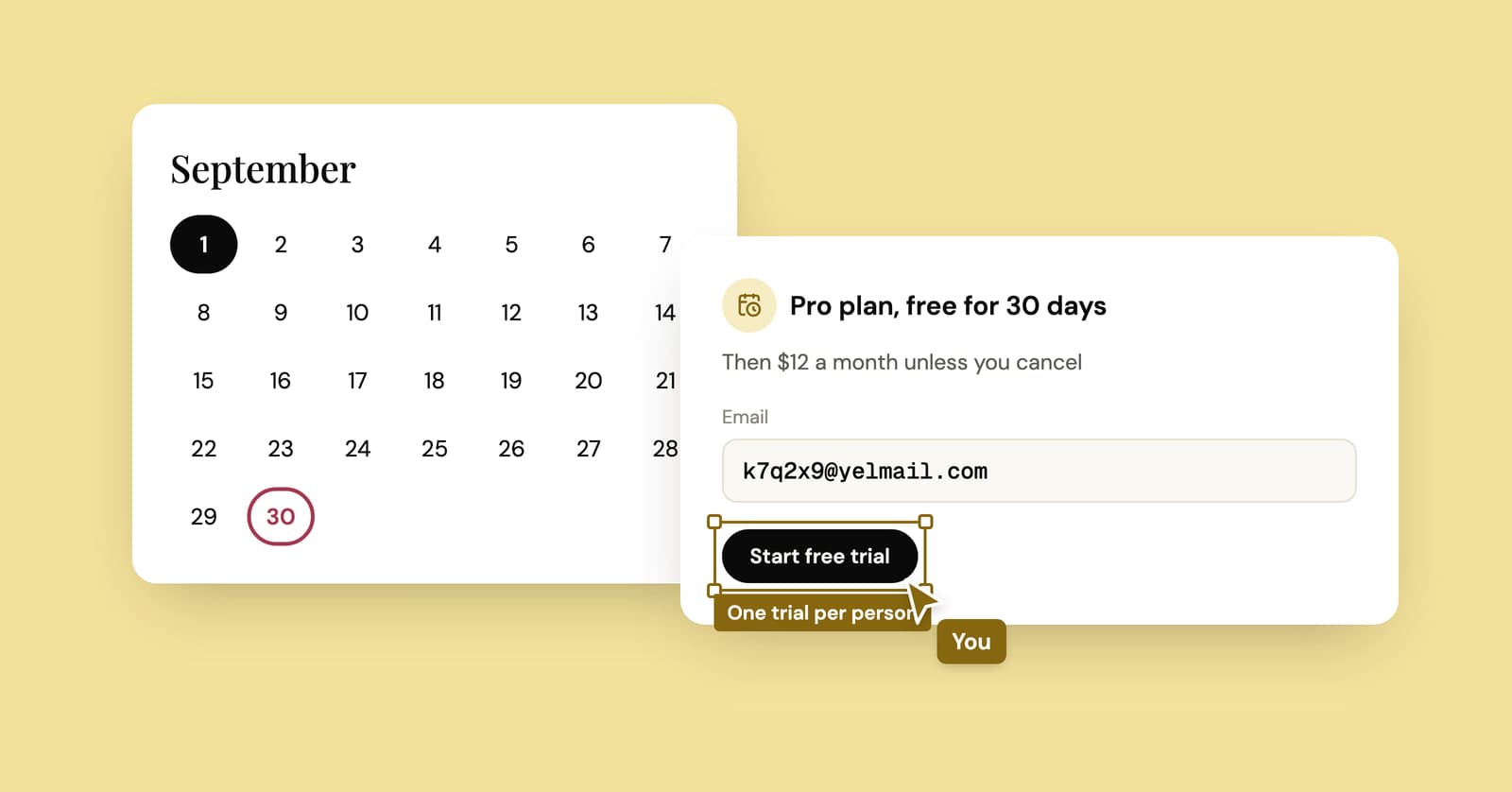
Using temp mail for free trials is fine when it's your first and only trial and you just don't want the sales emails that come with it. Using new addresses to restart a trial you've already had is a different thing. It breaks the service's terms, and it often fails anyway, because companies check your card, device and phone as well as your email.
Is it OK to use a temporary email for a free trial?
Yes, for a trial you're entitled to. The offer is for new customers, you are one, and giving a private address instead of your main one doesn't change that.
Good reasons to do it:
- You want to try a design tool or a streaming service before trusting the company with your real address
- The trial comes with a daily "getting started" sequence you will never read
- You're comparing competing apps and don't want all of them chasing you for a month
- You've never heard of the company and have no idea what it does with its mailing list
What counts as free trial abuse?
Trial abuse is taking a trial you're not entitled to, usually by posing as a new customer. Temp mail comes into it because a fresh address is the cheapest disguise, which is also why it's the first thing companies look past.
What crosses the line:
- Restarting the same trial with a new email when the old one runs out
- Making up names or details so you look like a different person
- Chaining trials across accounts so you never pay
Terms usually spell this out. Spotify's paid subscription terms, for instance, say that unless a trial is advertised as open to past subscribers, you must be a new subscriber who has never subscribed to, or accepted a trial of, a paid plan before. Plenty of software and streaming trials carry similar "new customers only" wording.
Why does repeating a free trial with new emails usually fail?
It fails because the email is the least important thing a company checks. It's the easiest detail to change, so trial systems lean on the ones that are harder to swap.
Trials that need a card can be matched on the card. Apps can recognize a device. Phone verification ties an account to a number. Billing names, addresses and payment history fill in the rest. A new email changes none of that, so a "new" customer on a known card can be refused on the spot or charged from day one.
When a company decides you're gaming its trials, the outcomes run from annoying to expensive: the trial is refused, you're billed straight away, the account is closed, or every account linked to you is closed, including the one you actually pay for.
It also has a cost for everyone else. Trial abuse is a big part of why some sites block disposable email domains, which spoils temp mail for people who only use it for privacy. Our post on whether sites should block disposable emails looks at that trade-off from the site owner's side.
On the legal side, breaking a site's terms is usually a contract matter rather than a crime, but knowingly deceiving a company to get paid services for free can amount to fraud in some places. This isn't legal advice; our post on whether temp mail is legal covers the general picture.
The real risk is forgetting to cancel
For honest users, the expensive part of a free trial is the charge at the end, not the trial itself. A temporary inbox makes that charge more likely.
The FTC's consumer advice on free trials and auto-renewals is blunt about it. You usually have to give a card number for a "free" trial so the company can charge you if you don't cancel before it ends. The FTC suggests putting a reminder on your calendar, and if you can't cancel, calling your card company and asking it to stop the payments.
Now put that trial on a temp address. The "your trial ends soon" reminder, the first receipt and any price change notice all go to an inbox that has already been deleted. The card still gets charged, and you find out from your bank statement.
How do you take a free trial without getting burned?
Decide before you sign up whether the trial can bill you, and choose the address to match. Then set your own reminder rather than trusting theirs.
- Read what happens at the end: the price, the date of the first charge and how to cancel. If you can't find all three, skip the trial.
- Put the end date in your calendar with a reminder two days early.
- If the trial needs no card, a free temp inbox is fine. There's nothing to renew.
- If it needs a card, give an address you'll actually read for the length of the trial: your real one, an email alias, or a YelMail Premium saved inbox, which keeps mail for 30 days and can forward it to your personal address.
- Cancel early if the service lets you keep access until the trial ends. Many do, but check first.
- Keep the cancellation confirmation. It's your evidence if a charge shows up anyway.
Step 4 is where temp mail users get caught. A free YelMail inbox keeps messages for 2 hours and expires after 2 hours without use, which is perfect for a confirmation link and useless for a reminder that arrives on day 27.
What if you decide to keep the service?
Give it an address you'll keep, and do it before the temp inbox expires. Change the email in the account settings while the old inbox can still receive any confirmation code, and from then on receipts, renewal notices and password resets reach you like any other account.
Some services don't let you change the account email at all. If that's the case and you already know you'll subscribe, cancel the trial account and subscribe from a new account under your real address, as a paying customer rather than a second trial. Our guide to moving an account off temp mail covers both routes.
Frequently asked questions
Can companies tell if I've already had a free trial?
Often, yes. Beyond the email, they can match the payment card, the phone number used for verification, the device or app install, and the billing name and address. A new email address changes none of those, so card-based trials in particular tend to catch repeat sign-ups. The usual result is a refused trial or an immediate charge.
Is it illegal to use a new email for another free trial?
In most places, breaking a service's terms isn't a crime on its own, and the usual consequence is a closed account or a charge. Knowingly deceiving a company to get paid services can be treated as fraud in some jurisdictions, though, especially where fake names or someone else's card are involved. This isn't legal advice. The simple rule is one trial per person per service.
Will I still be charged if my temp inbox has expired?
Yes. The charge goes to the card you entered, not to the email address, so an expired inbox doesn't stop a renewal. All it stops is the reminder and the receipt. If you started a card-based trial on a temp address, cancel from the account settings now, or at least put the end date in your calendar.
Why won't a free trial accept my temp email?
Some services block known disposable email domains at sign-up, often because of trial abuse. That's their call, and cycling through addresses to get around it isn't worth it. For a trial you're entitled to, use an alias or your real address and unsubscribe from the marketing afterwards. You'll want the end-of-trial reminder anyway, so an address you actually read is the better fit.
Before you click "start free trial"
Use a free temp inbox when the trial needs nothing but an email, and an address you'll read when it needs your card. Either way, the calendar reminder is what actually saves you money.
Keep reading
Temp mail for Steam and Epic Games: fine for a look, risky for your library
A throwaway address works for a demo, a beta or a game forum. On an account with games you paid for, it's a lockout waiting to happen at the next new-device login.
Throwaway email for Reddit: keep the throwaway actually separate
Reddit lets you run more than one account. How to give a throwaway its own email, what exposes throwaways anyway, and the two things Reddit won't tolerate.
Temp mail for Discord: fine for an alt, risky for your main
A temp address gets you into Discord in a minute. Where that works, when Discord asks for a phone, and how to keep the account if you end up liking it.